



19 Oct Case Study-Dickens: Stomatitis
Meet the Patient:
Dickens is an 11-year male neutered Maine Coon. He presented to Veterinary Dental Specialists in January of 2026 for an evaluation of suspected stomatitis.
Symptoms at Home:
A few months prior to presentation, Dickens family noted that he was having blood tinged drooling at times, and his gums and tissue in his mouth appeared very red and inflamed. He was brought to his veterinarian for a dental cleaning in January of 2026, where stomatitis was suspected and Dickens was referred to Veterinary Dental Specialists for further evaluation and treatment.
Diagnostics and Examination Findings:
During Dickens’ initial oral examination by our board-certified Veterinary Dentist, moderate to severe gingivitis was noted on the tissues behind his canine teeth. He was also found to have some missing teeth. A further evaluation under anesthesia was recommended, and Dickens’ owners moved forward with that plan.
Once Dickens was under general anesthesia, we were able to perform a much more thorough oral examination. The inflammation of the tissue extended all the way back to his pharynx, and findings supported the diagnosis of feline chronic gingivostomatitis (stomatitis). There was some hyperplasia (overgrowth) of the gingiva, and his tonsils were bilaterally enlarged. Gingivitis was present in all quadrants of the mouth.
To evaluate the health of the teeth and jaw beneath the gumline, we performed full-mouth dental radiographs and a CT scan of Dickens’ head. This advanced imaging revealed there was some mild bone loss and pocketing surrounding some of the teeth. A retained root and a root resorptive lesion were also found on his imaging.

This photo, taken prior to extracting the teeth, shows the inflammation at the back of the mouth.
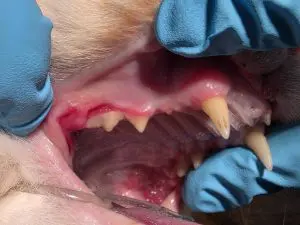
This is another photo showing the inflammation on his gingiva prior to treatment.
Treatment:
Dickens owner was presented with the option to extract several of the teeth, or to proceed with full mouth extractions. Full mouth extractions were recommended by the doctor as some cats with stomatitis do not respond well to only partial extractions and may need to be put under anesthesia again to have the remaining teeth extracted. Dickens’ family elected to proceed with the full mouth extractions. Nerve blocks were administered for pain control, and the remaining teeth were extracted. He woke up well from his procedure and was sent home to follow up in two weeks.
Recovery and Outcome:
Following his procedure, Dickens was sent home on two medications for pain control while he was healing. When Dickens presented for his two week recheck, the owner reported he was doing okay, but there was an odor in his mouth, and his appetite is slightly decreased. There were some episodes of drooling, and he hadn’t been cleaning himself like normal. Dickens was started on an antibiotic and was instructed to return for dehiscence repair under anesthesia.
On exam under anesthesia, it was found that while most of the sites were healing well, there were two small areas where there was dehiscence (the tissue had opened). There was still mild inflammation of the tissue in the mouth and throat, and Dickens was sent home on more pain medication and instructed to follow up.
One week after the repair, Dickens presented for a recheck. He was no longer drooling; he was cleaning himself again and was overall doing well. On exam the repair sites were healing well, and Dickens was sent home for further monitoring, and another follow up in one week.
Two weeks after the repair, Dickens was still doing well. There was one small area of inflammation noted on the exam, but he was healing well. The owner was instructed to continue soft food for another 4 weeks, and follow up at that time.
On his last recheck, Dickens was doing well at home, and everything looked good on his exam. The doctor did not feel the need for further rechecks and anticipated Dickens would continue to heal well.
Key Takeaways:
Stomatitis is an extremely painful condition that severely alters the quality of life for a cat that has been diagnosed. Treatment is always recommended, with the gold standard being extraction of all of the teeth in the mouth. Some patients recover well after a procedure to remove the teeth, but some cats still do require medication and pain control even with full mouth extractions having been done. It is important to continue monitoring behavior after treatment to make sure the patient is healing well and is not showing continued inflammation of the tissues.
Photo by Sergei Wing on Unsplash used with permission under the Creative Commons license for commercial use 10/19/2026
Author

Dr. Honzelka is a 1999 graduate of the University of Wisconsin School of Veterinary Medicine. After graduation he entered small animal practice. Although he enjoyed general practice, in 2006, he was “bitten by the dentistry bug”. He started attending as much dental CE and labs as possible. A few years later, Dr. Honzelka made the tough decision to leave general practice and enter a residency program in Dentistry and Oral Surgery. He became a Board-Certified Veterinary Dentist® in 2015. Dr. Honzelka is a Wisconsin native and worked at Animal Dentistry & Oral Surgery Specialists in the Milwaukee and Oshkosh area.
Publications:
Honzelka SR, Kressin DJ, Chamberlain TP. Modified Conservative Treatment of an Extensive Dentigerous Cyst in a Dog. J Vet Dent. 2014 Dec;31(4):249-254. doi: 10.1177/089875641403100405. PMID: 30870957.